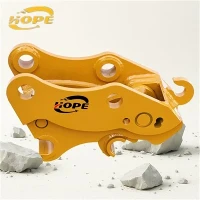
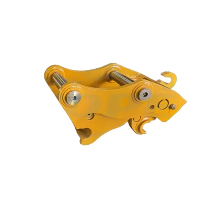
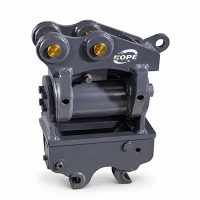
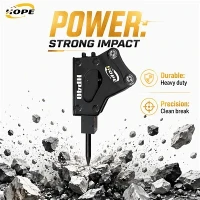
HOPE hydraulic coupler

Product Advantages
1. Standardize the changeover actions
By going through four steps-positioning, safety confirmation, and trial operation-it helps operators develop a clear changeover process and reduces repeated adjustments caused by missed steps.
2. Balancing Quick Operation and Mechanical Safety
The hydraulic drive helps make operations easier, while mechanical locks or safety structures provide extra connection security.
3. Reduce the workload of frequent manual pin removal
When the equipment and attachments are properly matched, operators can cut down on repetitive tasks like moving tools around, hammering pins, and manually aligning holes. This helps shorten equipment changeover preparation time and improve on-site organization.
4. Support for Attachment Combinations and OEM Matching
Manufacturers can help confirm connector sizes, control methods, hose layouts, colors, nameplates, packaging, and accompanying documents based on the excavator model, commonly used attachment combos, and project conditions.
Applicable Scenarios and Maintenance
Demolition work: Arrange consecutive operations between buckets, breakers, and hydraulic shears to reduce downtime waiting.
Roadwork: Coordinate breakers, buckets, and grading tools for demolition, cleaning, and preparation before backfilling.
Earthwork projects: Switch between rippers, buckets, or compaction attachments according to on-site needs.
Forestry and material handling: Configure equipment between grabs, buckets, and other handling attachments.
Check drawings, pins, center distances, ear plate widths, hose connections, and control methods before installation.
After changing attachments, make sure the attachment is positioned, hooks or pins are in place, and mechanical safety is engaged.
Before starting actual work, conduct a low-load test run to check for looseness, leaks, unusual noises, and locking status.
During breaking work, avoid subjecting connectors to lateral impacts beyond their intended use, prying forcefully, or improper dragging.
Regularly inspect pins, bushings, locking parts, cylinders, hoses, and welds; stop using immediately if any abnormalities are found.

Technical Specifications
|
Model |
Suitable Weight (ton) |
Pin Diameter (mm) |
Working Pressure (bar) |
Working Flow (L/min) |
Rotating Speed (rpm) |
Weight (kg) |
|
HP-02 |
5-9 |
45-55 |
120-175 |
35 |
6.8 |
155 |
|
HP-06 |
10-17 |
60-65 |
120-175 |
60 |
7.5 |
420 |
FAQS
Q:Can the same connector directly fit hydraulic breakers with different pin sizes?
A:They usually can't be used interchangeably. The pin diameter, center distance, ear plate width, and connection gaps can vary between different breakers, so you have to match them according to the specific dimensions. If you need compatibility with multiple breakers, you should provide the installation drawings or actual dimensions of each attachment before purchasing, so the manufacturer can confirm whether you need to replace connection parts, set up an adapter, or have custom parts made.
Q:How should the hydraulic coupler hoses be arranged?
A:The hoses should be kept away from sharp edges, friction points, high-temperature areas, and the movement range of the coupler. Make sure to leave enough slack to avoid stretching, bending, or squeezing when the excavator moves. After installation, check the full range of motion to ensure the hoses don't interfere with the boom, coupler, or breaker. The exact arrangement should follow the on-site installation plan.
Q:If the hydraulic system loses pressure, how should you handle an already connected breaker?
A:The approach depends on whether the connector has a mechanical lock, manual release, or emergency unlock feature. When the hydraulic system is depressurized, you shouldn't force the latch, hammer the pin, or stand under a suspended attachment. First, make sure the equipment is turned off and the attachment is securely supported, then follow the emergency procedures in the manual, and have a professional check the locking mechanism and hydraulic system.
Hot Tags: hydraulic coupler, China hydraulic coupler manufacturers, suppliers, factory, compact excavator quick hitch, Excavator Double Lock Quick Coupler, Hydraulic Quick Connect Assembly, Hydraulic Quick Hitch, quick change excavator coupler, Tilting Quick Coupler