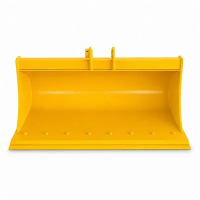
Common materials used for excavator buckets include Hardox high-strength wear-resistant steel, NM360 wear-resistant steel, and Q345B structural steel. These materials are utilized in various combinations and reinforced designs-such as the addition of bottom reinforcement plates and side guard plates-to withstand heavy-duty operating conditions. The chemical composition of Q345B steel consists of 0.18% C, 0.55% Si, 1.4% Mn, 0.03% P, and 0.03% S; it features a Brinell hardness of 163–187 HB, an elongation of 21%, a tensile strength of 470–660 N/mm², and a yield strength of 345 N/mm². The chemical composition of NM360 wear-resistant steel consists of 0.20% C, 0.3% Si, 1.3% Mn, 0.02% P, and 0.006% S; it features a Brinell hardness of 360 HB, an elongation of 16%, a tensile strength of 1200 N/mm², and a yield strength of 1020 N/mm². The chemical composition of HARDOX-500 high-strength wear-resistant steel consists of 0.20% C, 0.7% Si, 1.7% Mn, 0.025% P, and 0.01% S; it features a Brinell hardness of 470–500 HB, an elongation of 8%, a tensile strength of 1550 N/mm², and a yield strength of 1300 N/mm².
The manufacturing process for excavator buckets typically involves stages such as material cutting, forming, and welding. Following the welding process, an integrated boriding-and-quenching technique can be applied to enhance wear resistance. This integrated technique utilizes Q345 steel as the base material and is achieved through paste-based boriding followed by quenching. The optimal process parameters involve a boriding temperature of 920°C maintained for 7 hours, with the addition of 2% rare-earth elements to catalyze the diffusion process. After treatment, the borided layer consists of a single-phase Fe2B structure; its hardness is eight times that of the base material, and its relative wear resistance reaches a value of 8.29-approximately 5.7 times that of conventionally quenched 22SiMn2 steel.