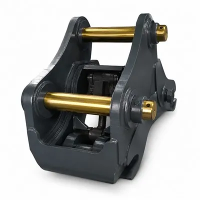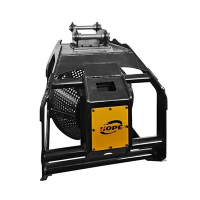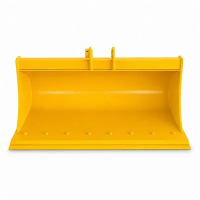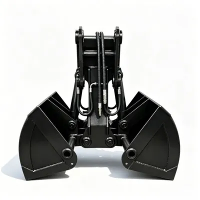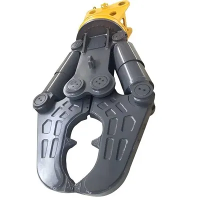
The excavator bucket is a core structural component of an excavator, fabricated by welding together parts such as the tooth base plate, bottom plate, side plates, wall plates, and hanger plates. More detailed designs may also incorporate additional components, including back plates, bucket ears, ear bushings, bucket teeth, tooth adapters, wear plates, or corner teeth.
Excavator buckets are primarily categorized into two types: backhoe buckets and face shovel buckets. When a face shovel excavator is in operation, the digging force is directed upward from below, making it suitable for excavating materials situated above the machine's standing level; conversely, when a backhoe excavator is in operation, the digging force is directed downward from above, making it suitable for excavating soil layers situated below the machine's standing level. A patent titled "Excavator Face/Backhoe Converter," obtained by the Third Harbor Engineering Co., Ltd. of CCCC, enables the conversion of a single bucket to perform both face shovel and backhoe functions. Furthermore, a patent titled "High-Efficiency Discharge Excavator Bucket," applied for by Gaoyou Xunda Construction Machinery Group Co., Ltd., utilizes an airflow-driven mechanism to enhance material discharge efficiency.
The quality of the welding directly impacts the structural strength and service life of the bucket. The manufacturing process involves stages such as material cutting, forming, and welding, which require the use of specialized equipment such as CNC plasma cutters and welding manipulators. Depending on the specific operating environment, bucket materials are classified into three types: Standard (Q345B steel), Reinforced (Q345B steel with NM360 wear-resistant steel reinforcements), and Mining (HARDOX ultra-high-strength wear-resistant steel). Certain models are manufactured using Hardox steel plates to further enhance wear resistance. Buckets designed for special operating conditions are capable of withstanding extreme temperatures ranging from -40°C to +45°C, as well as environments at altitudes exceeding 3,000 meters. To further improve wear resistance, the surface of the cutting edge can be treated using plasma cladding technology to deposit a high-entropy alloy coating with the composition FeCoCrNiAl0.5Ti0.5; this coating achieves a hardness 1.46 times that of NM400 steel and reduces mass loss due to wear by 52%.