1. Hydraulic Principle
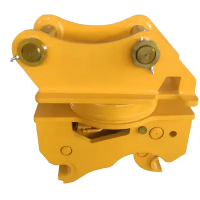
Hydraulic quick couplers primarily rely on the action of a hydraulic cylinder to engage and disengage pins 1 and 2. When a work attachment needs to be changed, the hydraulic cylinder retracts; the hook-shaped locking block moves from Position 1 to Position 2, thereby disengaging the quick coupler. Once the new work attachment is in place and the locking block is aligned with its pins, the hydraulic cylinder extends; the locking block moves from Position 2 back to Position 1, securely locking the pins of the work attachment. Naturally, this process also involves the simultaneous operation of external hydraulic lines and solenoid valves.
2. Mechanical Principle
Mechanical quick couplers produced by domestic manufacturers generally fall into two main categories: the pin-type and the screw-type. Taking the pin-type as an example: when a work attachment needs to be swapped, the wedge pin is first withdrawn, and the T-handle is tapped inward. (The T-handle is designed to smoothly retract the red locking block; however, this mechanism places high demands on welding quality-if the guide rails are not welded flat or are not thoroughly ground and cleaned, the movement of the red locking block will be hindered and will not operate smoothly.) This action disengages the quick coupler from the bucket. Once the desired work attachment is in place, the T-handle is pulled backward, and the wedge pin is inserted through the T-handle to secure the lock.