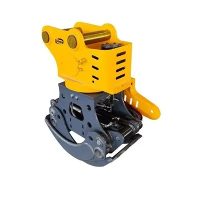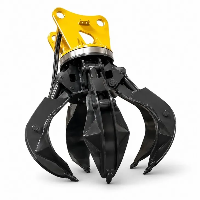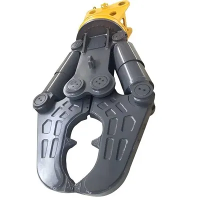
Every scrap yard has the same backlog: a row of end-of-life cars waiting to become feedstock again, and the difference between "waiting" and "feeding the baler" is measured in how fast the metal gets cut. Torches are slow and risky around fuel tanks, and a general-purpose shear wastes half its reach on vehicle geometry. That is the gap a hydraulic car scrap shear was built to close - a cutting tool made for the specific shapes of car frames, chassis rails and body panels, sized to turn a 12–32 tonne excavator into a dismantling machine.
Why car dismantling needs a dedicated shear
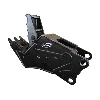
A car is not a flat sheet of steel; it is a box of mixed shapes - boxed frame rails, stamped body panels, suspension arms, door pillars - and a shear has to grab each shape differently. General-purpose shears cut wide, flat material well and struggle with the rounded, closed sections of a vehicle body. A car scrap shear uses a front crocodile-style clamping jaw that grips irregular scrap tightly, so the cut starts clean instead of the piece sliding out of the blades. And because no flame is involved, the obvious dangers of cutting near fuel residues and sealed cavities disappear from the yard.
Match the model to the excavator
The range covers the carriers scrap yards actually run. The HP-06 suits 12–18 tonne excavators with a 670 mm jaw opening and 160 tonnes of shear force. The HP-08 steps up to 19–24 tonne machines, opening 840 mm with 208 tonnes of force. The HP-10 tops the line for 25–32 tonne carriers at a 960 mm opening and 249 tonnes - enough to cut through truck frames and thick chassis sections in a single bite. Sizing follows one rule: the jaw has to close around the largest section on the vehicles you dismantle most, and the weight has to stay within what your excavator handles comfortably.

Force and blades that survive a scrap yard
Scrap car chassis are not clean material; they are rusted, painted, sometimes concrete-filled. The shear is fabricated from heavy-duty wear-resistant steel so the structure resists permanent deformation even after thousands of cutting cycles, and the hardened blades hold their edge far longer than standard steel in that environment. Every component is machined to tight tolerances, which shows up on site as smooth operation and steady cutting through a full shift - no unplanned downtime, no irregular cuts.
Rotation is where the hours go
In high-volume dismantling, the excavator moves more than the shear cuts. An optional 360° hydraulic rotation lets the operator position the tool at any angle without repositioning the whole machine - reaching a door pillar here, flipping the shear for a chassis rail there - and that is the difference between a yard that processes a dozen cars a day and one that keeps chasing its own machine around the lot. It is optional for a reason: yards with simple layouts can save the cost, while high-throughput operations usually find it pays back in the first month.
Where it works beyond the car yard
The same shear carries over to the rest of the metal business. Scrap metal processors use it on steel scrap, structural steel and mixed metal waste, prepping material for resale and transport. Demolition crews cut through reinforced concrete steel, rebar and structural components with it. And salvage operations pull metal out of construction debris and industrial waste. One attachment that starts in the car yard and finishes in the baling yard.
For an auto recycling facility, the choice is not whether to cut cars - it is which tool does it fastest without setting the yard on fire. Pair it with a hydraulic scrap shear on a larger carrier for the heavy beams and plate that a car shear is not sized for, and the two tools cover the whole metal stream. That is how a yard stops measuring its backlog in weeks.