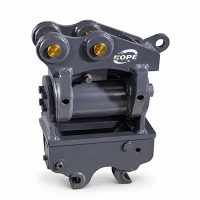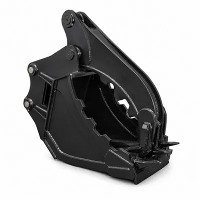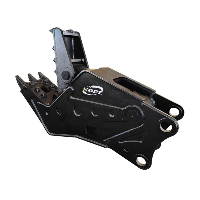
Pile driving looks like brute force: a heavy weight, a hard impact, a pile hammered into the ground. But a large share of modern foundation work uses a completely different method. An excavator pile hammer - technically a vibratory pile driver - does not hit the pile at all. It vibrates it. Mounted on an excavator and powered by its auxiliary hydraulics, this attachment drives and pulls sheet piles, H-piles, pipes, rails and concrete piles with high-frequency vibration, often through clay and dense soils where impact hammers struggle. Here is how it actually works.
The principle: vibration, not impact
Inside the hammer are rotating eccentric weights. As they spin at high speed, the off-center mass generates a centrifugal force that pushes the machine up and down in a rapid vertical oscillation - typically 2,800 to 3,000 cycles per minute. That vibration is transferred directly into the pile clamped beneath the hammer. The pile does not get punched into the soil; it gets shaken into it. The rapid up-down motion temporarily liquefies the soil particles around the pile's surface, letting them rearrange and flow around the pile as it sinks under its own weight and the weight of the machine. Pulling a pile works in reverse: the vibration breaks the soil's grip, and the excavator lifts the pile out cleanly.

Why vibration wins in the right ground
Impact hammers need room to swing a weight and can be noisy, and they struggle in certain conditions. Vibration works differently: because it changes the soil's behavior at the pile face rather than relying on raw kinetic energy, it drives piles fast and smoothly in granular and cohesive soils - the product page notes it works even through hardpack clay and dense ground. It is also far gentler on the pile itself, which matters for steel sheet piles that would buckle under repeated impact, and it pulls piles as easily as it drives them, which makes temporary works - cofferdams, retaining walls, flood barriers - genuinely reusable.
Understanding the principle also makes the purchase decision simpler. If your work involves sheet piles, H-piles, pipes or concrete piles - and your excavator's auxiliary hydraulics can supply 320 kg/cm² at 250–300 l/min - an excavator pile hammer turns one machine into a foundation crew. Match the model to your carrier, read the centrifugal force against your soil, and you get the same reliable result on a river cofferdam as on a highway bridge: piles in, quickly, securely, and back out again when the job is done.